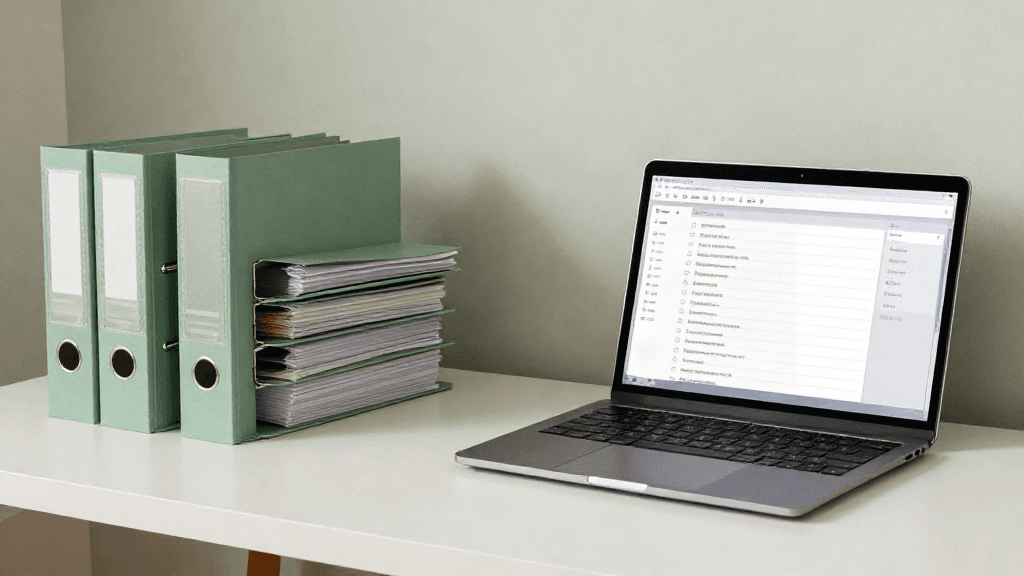
Your home shouldn't live in your memory.
Yet for most homeowners, that's exactly where it ends up. The furnace filter change date is in your head. The warranty for the water heater is in a drawer somewhere. The receipt for last year's roof repair is buried under a pile of mail. And the paint color you swore you'd remember? Gone.
None of this is because you're disorganized. Home maintenance is almost universal. Staying ahead of it isn't. The real question isn't whether you care about your home — it's which system you use to keep it organized.
Here's the honest comparison between the two real options: a paper home management binder and a digital home management system. We'll weigh them side by side so you can pick the one that actually works.
The Case for a Paper Home Management Binder
A paper binder has a lot going for it. It's tangible. It's private. It costs almost nothing to start. And for a certain kind of person, writing things down by hand makes them stick.
What a binder does well
- It's always in one place. When everything lives in one binder on a shelf, you always know where to look.
- No learning curve. Anyone can open a binder and flip to a tab.
- It works offline. No batteries, no Wi-Fi, no login.
- Writing helps you remember. There's real evidence that physically writing something down improves recall.
Where a paper binder falls short
- It only works if you update it. A binder is only as good as its last entry. Skip a month and it's already out of date.
- It's easy to lose. Binders get moved, borrowed, or buried. One move and your whole system is a box in the garage.
- Nothing is searchable. Need to find the warranty for the dishwasher? You're flipping pages, not typing.
- It doesn't remind you. A binder sits there waiting for you to open it. It never tells you a filter is due.
- It can't travel with you. When you're at a store trying to match a part number, your binder is at home.
The Case for a Digital Home Management System
A digital system solves the problems paper can't. Instead of relying on memory and manual upkeep, it does the remembering for you.
What a digital system does well
- Everything is findable in seconds. Search, don't flip. Need the HVAC warranty? Type it, done.
- It's always with you. Your home's records live on your phone, so they're available at the store, on the job site, or at the contractor's office.
- It reminds you before things become problems. Filter changes, inspections, and warranty expirations get scheduled instead of forgotten.
- It's backed up. Lose your phone and your records are still safe. Lose a binder and they're gone.
- It scales. Paper systems get messy as they grow. Digital systems handle years of history without a single extra shelf.
The honest trade-offs
- You need a device. A digital system assumes you have a phone, tablet, or computer. Most homeowners do.
- There's a setup cost. You have to enter your home's details once. That upfront effort is real, but it's a one-time investment.
The Real Difference: Memory vs. System
Here's the core of it. A paper binder is a place to store information. A digital system is a tool that puts that information to work.
Paper holds your records. Digital tracks them, schedules them, and tells you what's next.
Most homeowners aren't ignoring maintenance. They're just relying on memory, and memory fails under a full schedule. You don't need to remember more. You need a system that remembers for you.
Where the Homeowner Control System Fits
If you're leaning digital, the Homeowner Control System is built exactly for this. It's a digital home management system with 250+ fillable PDF pages and a smart spreadsheet dashboard that tracks maintenance, repairs, warranties, and more.
You get the structure of a binder, but it's searchable, always with you, and it schedules the work so nothing slips. It's a one-time purchase with three tiers, so you pay once and own it. No subscription, no recurring cost.
The Bottom Line
Choose paper if you want something tangible and you're confident you'll maintain it every single month.
Choose digital if you want your home's records organized, searchable, and always with you, without relying on your memory.
For most homeowners, the answer is clear. Your home shouldn't live in your memory. It should live in a system that stays ahead of the work for you.
That's what finally makes home management feel simpler.